For this week's look into gameplay and narrative, I looked at Never Alone.
Never Alone readily takes up the the 'string of pearls' method - gameplay, followed by a 'pearl' of story, followed by another 'string' of gameplay, and so forth. This approach to narrative in games can be a difficult one, as you need to balance out the two so that the player both has enough time to interact and play, thus keeping them interested, but also not so much that the story 'pearls' get spaced so far apart that the story is forgotten by the time you reach the next cutscene (some of the Silent Hill games, in particular, have been terrible at this - not because the story was too far apart, but because frquently you could spend hours upon hours, running back and forth, searching for a tiny piece to solve one tiny puzzle - and you'd normally encounter many of these puzzles between each narrative segment. Or wind up with having to open and search rooms A through to M, or something of the like. However, this isn't about the Silent Hill series).
Never Alone was relatively good at balancing the two - after each puzzle, you'd receive a short segment of the story, making the narrative segments much like a carrot on a stick - you progress through the puzzles, following the narrative segments dangled in front of you. The approach worked well with the occasional lines of narration that would sometimes be prompted as you completed a part of the puzzle, reminding you that there is a story there too.
Never Alone made each narrative segment feel like a reward, and having each scene be rather short, kept it from becoming too much like it was straying too far from the gameplay.
Playing it myself, I personally didn't find the story engaged me too greatly, but that would likely be down to personal preference. I found the gameplay, and the puzzle solving to be more what encouraged me to continue with my progression through the story, and the narrative segments to be more of a pleasant break, but definitely not quite enthralling enough that I'd want to rush ahead and seek the next piece of the story.
It did keep me interested, and overall I definitely enjoy the game, but in this instance, specifically, I found the gameplay to be more my motivation than the actual narrative.
Thursday, 10 March 2016

Tuesday, 8 March 2016
09/03/16 - Production Studio (Cinematic) - Group Script
The script took a huge rewrite, based off of Ethan's original idea, but with a lot of revision to make the story and ideas flow better.


Wednesday, 2 March 2016
03/03/16 - Interactive Narrative - Facade
Halfway through attempting to install this game on my laptop, which caused first the installer to freeze, then my laptop to freeze, then to freeze on the reboot screen, I wondered 'why did I choose this game again?'.
But my reasoning was relatively simple - having played all three of the suggested games for this week, I chose the game that was a) the most interesting to me, and b) the game that had your choices matter the most (to an extent).
Ironically, then running the weirdly installed version led to a scenario with no audio, aside from the chosen name (Chloe), and the couple arguing wildly, ignoring most of my comments, and responding to things that had never been actually said.
Clearly, not the intended experience.
No worries, I got the game working as intended - plus having played (a lot) before, I knew the general principal of the game.
The way the story is built in Facade is relatively simple, using a generic three act structure. We start off with a small audio clip, indicating that we are an old friend of Trip and Grace, and that we're meeting them to see their new apartment. Begin Act 1. We're welcomed into their home, and introduced to the characters. We learn that Grace works in advertising, and used to be an artist. She comes from a well off family. Trip is harder to learn about, but we can learn that he came from a poor family, or that he frequents sports bars. Act 1 is driven forward relatively quickly, as a problem is quickly introduced - albeit not entirely clearly. In a tradition Three Act Structure, Act 2 should be prompted by a catalyst, to set things into motion. In Facade, isn't clear to start what, exactly is the specific catalyst - perhaps it's you being there, perhaps it's the new apartment - but regardless, it's noticable that there is some tension and disagreement between the two, which can be picked up in the fact that they are arguing before they ever open the door to let you in, should you sit and listen a little, rather than immediately knocking. The conflict here - which in game, is in the form of Trip and Grace's arguing, with you taking on the role of mediator - spans the majority of the game, with each character raising points and asking you questions, which can escalate into a heated debate, with multiple potential endings - either a successful resolution, either Trip or Grace leaving, should you side with one more than the other, or finding yourself escorted out of the house. These potential endings, although rather short, create Act 3, in which the story, and the points leading up to it, are summarized and end. Interestingly, it's clear to tell when you have reached an 'end', or the third act, as, in at least the cases of the bad endings, (they divorce, or toss you out) the characters will announce that they have either 'had enough', or in the divorce endings, ask you 'is everything you've said tonight supposed to mean something?'. At this point, nothing you can say or do matters anymore, or matters very little.
Though, it's not the first time interactivity in this game means very little. Logically, the point of the game is for you, the player to prompt responses, and respond either postively, or negatively, to their questions. However, it's entirely possible to complete the story, without ever speaking a word. Your interactions, although intended to be the force driving the story forward, do not matter. The characters talk, and should they not receive the answer they want - or any at all - will simply move on to their next point.
And even when you do interact, and attempt to drive the plot in the direction you want it, in many cases, the AI will outright ignore you, or talk over you, driving the topic forward before you even have a chance to reply.
Your input into this story may feel like it has weight during your first attempt. Or maybe you'll miss the story so easily, as many people do, instead finding it humorous to yell random things at the pair, hoping to spur a response. But you play it again. 'Didn't they say this last time?', you wonder, attempting to change the direction of the story, or seek a different conclusion. You attempt to throw in new keywords, hoping for a new line of investigation, only to get yet another 'uhh...' as the characters fail to register your point, and continue with their lines as normal.
And as a test - I played the entire game, doing nothing but saying 'potato', constantly, and managed to get the ending in which they both stop, and deny that anything has gone on, saying they're fine, and that you should leave.
'What does this picture say to you?'
'potato'
'That's a great answer!'
The most interesting point with that, was that Grace raised the point 'You don't even give me a yes or a no answer when I ask', suggesting that they were aware, that yes, I was shouting gibberish at them. But it didn't change the story, at all. In refusing to participate in the story, it carried on without me.
Facade isn't a bad game. But from what I can see, your choices do not matter a great deal, and the narrative will continue regardless of what you do.
03/03/16 - Production Studio (Cinematic) - Production Schedule

Blogger refuses to size this nicely so that it both fits and isn't too small.
Saturday, 27 February 2016
28/02/16 - Production Studio (Cinematic) - Personal Script
I'm not sure where to upload my script idea, so it can go here anyway. (uploaded as images to save the formatting and not have to redo it, but this site really doesn't offer very good choices on image sizes)


Thursday, 25 February 2016
26/02/16 - Production Studio (Cinematic) - Story Concepts
New year, new tasks. Let's get this thing started, and hopefully, remember to keep this going every week.
So, brainstorming concepts.
I figured why not start with base genres, seeing as that was the suggested idea and exercise, with the mashup genre thing we did.
So I thought to myself, what're the main genre's that I personally tend to watch or like? And then which genre's will easily lend themselves to having an additional, animated character?
Liked:
- Horror
- Adventure
- Action
- Fantasy
- Thriller
Easily animated (my basis for this was really 'which film genres can easily be characterized by non-human characters (although logically any can, but I was aiming for the more common types)) :
- Horror
- Fantasy
- Action
- Sci - fi
So, here I have a pool of monsters, supernatural creatures, or aliens.
Horror was high up my list, so I started thinking what kinds of horrors are there? Monsters, slashers, crime, paranormal, survival - it's a long list.
Based off this, I thought 'why not come up with concepts springing from as many of these subgenres as I can think of'?
Monster:
- While hiking alone in the woods, a hapless young adult is chased by large, horrific beast, until eventually they find themselves cornered, with no chance of escaping. "You dropped your wallet" the beast tells them.
Crime:
- A beat down ex-detective, who lost his job after his family were murdered by a mysterious presence. Years later, he's finally found the creature, and it's time to get his revenge.
- A shady conman, who's skills at cards and other tricks are actually due to their partnership with a malicious evil being.
Paranormal:
- Do pets go to heaven? A man wishes so, as his deceased pet refuses to move on, and he finds himself stuck with a zombified dog that he just can't bear to part with a second time.
Out of these, the main concept I seemed to picture actual visuals for was the first crime idea.
I picture a man in a large trenchcoat, never seen facing the camera, monologuing in a gruff voice as he follows a hooded figure down a crowded street, explaining who the figure is. The figure notices they are being followed, showing the viewer a brief glimpse of an inhuman face, and the chase is on, til both end up in a dark alley for the final showdown.
The clip could end with a single bullet being fired by the detective, leaving the outcome unknown. The monster would be animated in 2D, and the bullet could be the 3D prop, leaving the detective to be played by the live actor.
This is most likely the concept I'll attempt to flesh out and script over the weekend.
Wednesday, 11 November 2015
Finished Animation and Rationale - 12/11/10
So.
Here we are.
We've made it to the end of this project.
And yes, I skipped blogging the lighting progress - mostly because I forgot to screenshot it, and tomorrow I jump on a plane back home.
But I'm pretty proud of myself.
I learnt a lot of things throughout this process.
I started with really bold expectations - a huge storyboard, big ideas, and big designs.
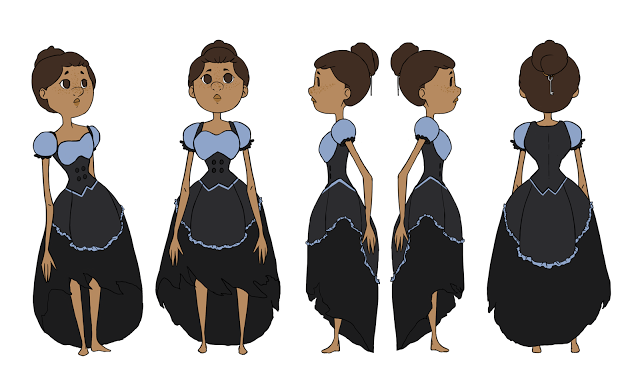
I wound up simplifying out the jagged edge of her skirt in the final 3D model, and cut out the key in her hair - as cute as the idea was.
My initial storyboard was six pages long, and involved 9 separate shots. I knew it was never going to fit in the 6 second clip we were supposed to animate, but I had all these grandiose plans to fully draw out all of the panels that weren't going to make it into the actual shot, to give context and the rest of the story.
I also had a complex environment - and a second character! - both of which I simplified down a lot. The sign posts based around the tower are gone, and so is the extra character (and his horse).


These two pages were the clip I used to animate.
I also changed a lot of the camera angles from these, to accommodate for the removal of the extra character - shifting it to partly play out from his perspective, and to accommodate some... well. Poor choices earlier.
I'm proud of the character model itself, but...

Or - a basic character design flaw - the fact that with a head that large, she couldn't raise her arms high enough above her head to raise the sword as much as I wanted, without clipping inside her skull.
I made do with what I had, but I hadn't really given myself the greatest advantage.
When we hit the animating stage, I realised very quickly that I didn't overly enjoy the animation step of the process (which would figure, being a student at an animation school and all). I really preferred designing the character, and making a 2D drawing pop to life in a 3D model.
I struggled a little, with a less than perfect grasp of how to use Maya, and how animation principles worked.
So is it perfect?
No. Of course not.
Did I struggle, and make a lot of mistakes?
Naturally.
But I made it, and completed something I'm proud of, regardless.
Next year, I'll know better.
Subscribe to:
Posts (Atom)